RescueFit
21 Sep 2026Cognition v4.3 is live. On a building fire the traffic now plays over a cutaway of the building — who is on which floor, where the line is, who is talking. And every kind of rig knows what it is for: an off-profile order is offered and costed instead of hidden. More → all updates
Gated

Rope Rescue Systems

Three rope systems built one step at a time on a 3-D drawing you can spin — the twin-tension Clutch lower to raise, the skate block, and a rappel to a pick-off. Every step goes on with the reason, and the manufacturer's own sentence is one tap away.
3 rope systems17 steps on System 113 knot cardsRope v0.70
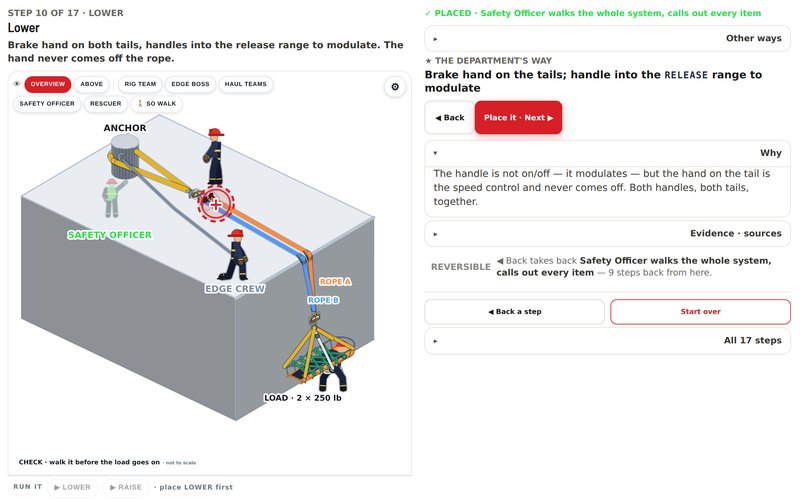
System 1, the lower. Step 10 of 17: brake hand on both tails, handles into the release range. The Safety Officer, the edge crew, both ropes over the edge to the litter, and the reason beside it.
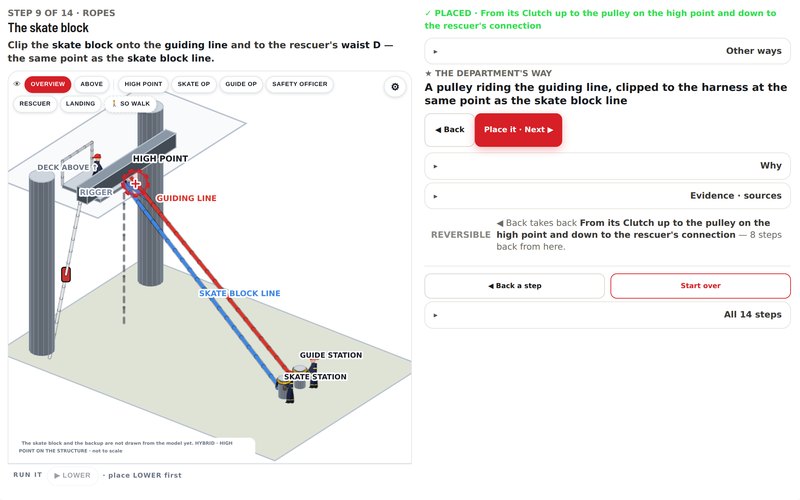
The skate block. The hybrid on a structure: the high point, the guiding line in red, the skate block line in blue, each down to its own Clutch station.
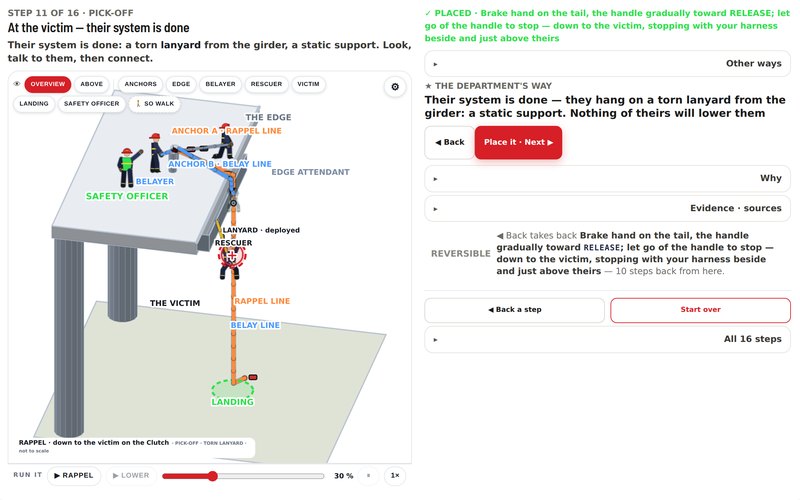
The pick-off. System 3, step 11 of 16: the rescuer on the rappel and belay lines off two anchors, down beside a victim whose own system is done.
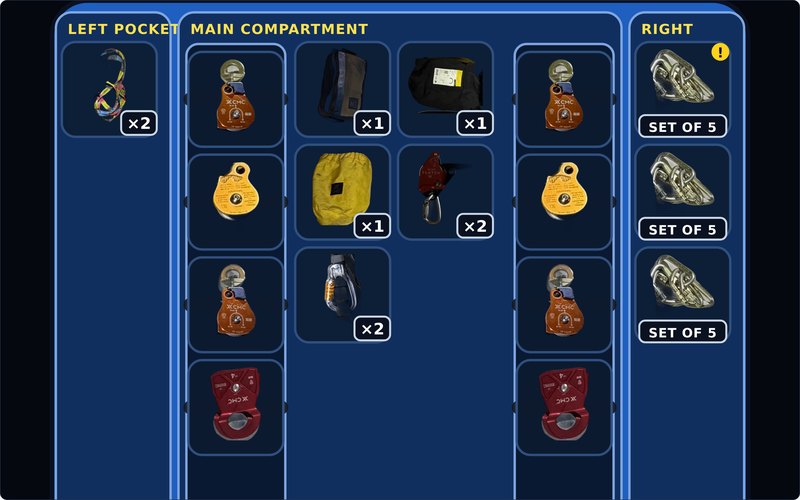
Out of the bag. A rope bag opened pocket by pocket, every piece a cut-out photo of the department's own gear, with the count.
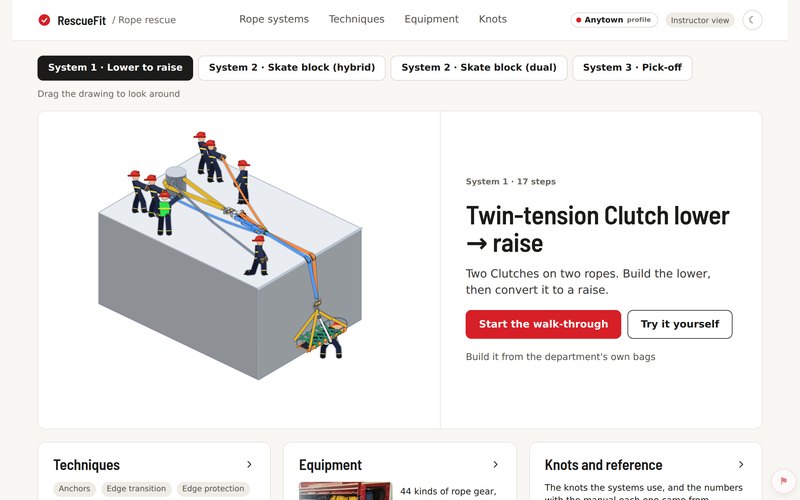
Home. The systems across the top, System 1 spinning in 3-D, and two ways in: the walk-through, or try it yourself.
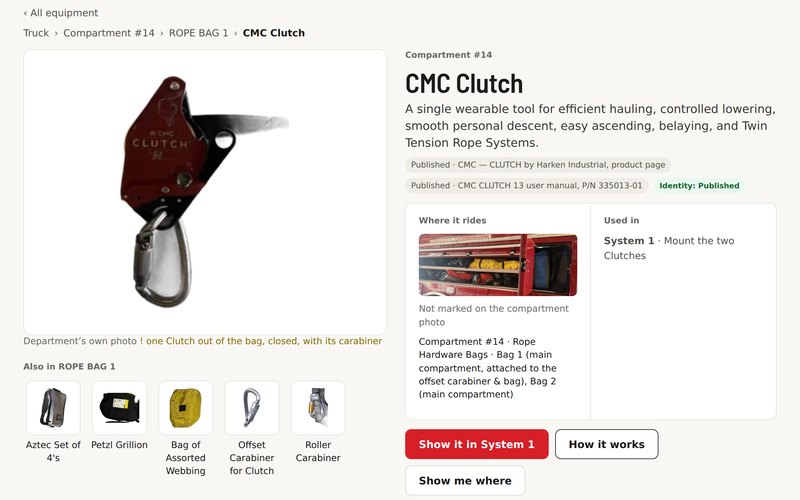
The Clutch. One card per piece of gear: the photo, the maker's own description and manual, where it rides, and what it is used in.
01

Build it

Seventeen steps on System 1, each placed on the drawing with the reason. Guided shows you, Try it yourself asks — shuffled and unmarked — and Build from the bags hands you the department's bags and no list.

02

Spin it

A 3-D drawing you drag round. Keys stand you with the rig team, the edge boss, the haul teams, the Safety Officer or the rescuer. Run it plays the lower and the raise.

03

If it locks

Wherever the ASAP LOCK is on the rope: what Petzl says, the one release Petzl publishes, what nobody publishes, and the department's way — marked not confirmed until it is.

04

Talk it over

The after-action report: what you built in order, where you left the class's way and what that traded, and what the run never touched. The time is telemetry, not a mark.

System 1, the lower. Step 10 of 17: brake hand on both tails, handles into the release range. The Safety Officer, the edge crew, both ropes over the edge to the litter, and the reason beside it.

Three verdicts, never a wrong

Trainer's way is the one the class runs on. OK works, with a trade-off you read once the step is placed. NO is only what a manufacturer rule or a safety rule forbids, and the rule is on the screen. Evidence on any step opens the manufacturer's own sentence and the manual it came from.

Drag the drawing to spin it. It fills in as each part goes on; tap any part for what it is. Run it plays the lower and the raise, and Bounce shows every jerk landing on the litter.

Out of the bag. A rope bag opened pocket by pocket, every piece a cut-out photo of the department's own gear, with the count.

Out of the department's own bags

Every part is a cut-out photograph of one department's real gear, and the bags open on the screen pocket by pocket. Build from the bags on System 1 takes the list away: open a bag, pick the part, place it.

The equipment page is the department's inventory sheet, line for line, with the cell each count came from. Where the sheet doesn't settle something, the app says so instead of guessing.

The skate block. The hybrid on a structure: the high point, the guiding line in red, the skate block line in blue, each down to its own Clutch station.

The skate block, and where they land

An offset lower that puts the package down away from the plumb line. Hybrid — a guiding line and a skate block line, a Clutch at each station — or dual. The high point is a beam on the structure or the Vortex, with MATSAT walked before the ropes are loaded.

Where do they land takes the height and the distance out and shows the touchdown. On the dual, the app's derived figure and the field estimate sit side by side, each labelled for what it is. On the hybrid the guiding line's tension steers it, and no published source gives a target tension — the screen says so.

The full list

Three systems
  • System 1, the class opener: a twin-tension lower on two CMC Clutch 13s, then the raise — a prusik grab, one double pulley across both ropes for the 3:1, and the conversion to a 5:1. Seventeen steps.
  • System 2, the skate block: an offset lower that puts the package down away from the plumb line. Hybrid — a guiding line and a skate block line, a Clutch at each station — or dual.
  • The skate block's high point is a beam on the structure or the Vortex. On the Vortex the drill adds its own steps and walks MATSAT before the ropes are loaded.
  • Two optional improvements on the skate block, off by default so the basic rig goes together first: the AZTEK for height control, and a small MA to put tension on the guiding line.
  • System 3: rappel on your own Clutch with a belay line off a second anchor, then either ascend back to the lip or pick off a victim — one hanging on a working system, or one whose lanyard has torn.
Build it, one step at a time
  • Guided walk-through: tap Place it · Next and each step goes on the drawing with the reason. Back takes a step off, as often as you like.
  • Try it yourself: the same steps asked as questions, the answers shuffled, nothing marked. Tap what you'd do and it tells you which way you picked, and why.
  • Three verdicts, never a wrong. Trainer's way is what the class runs on. OK works, with a trade-off you read once the step is placed. NO is only what a manufacturer rule or a safety rule forbids, and the rule is on the screen.
  • A refused answer stays on the list, struck through, so you see what's gone — and the question stays open until you place something.
  • Build from the bags, on System 1: no list. Open the department's bags, pick the part, place it.
  • Free build, in the instructor view: every step on one list, in any order the rig allows. A step waits until what it hangs on is there.
The drawing
  • Drag it to spin it. It fills in as each part goes on; tap any part for what it is.
  • Keys along the top stand you with a team. On System 1: the rig team over the plate, the edge boss, behind the haul teams, the Safety Officer, the rescuer on the wall. The skate block adds the rigger at the high point, each line's operator, and the landing.
  • The check is a step: the Safety Officer walks the whole system out loud, anchor to load, before anyone puts weight on it. In the instructor view, Walk it takes that route round the finished rig, station by station — including “either rope, alone: would it hold this whole load?”
  • Run it plays the lower, the raise, the rappel and the ascend — rope paying out, the load moving along its path. Bounce shows every jerk landing on the litter. It's a drawing pace, not a rope speed.
  • Full screen puts the step beside the drawing for a projector, and a USB clicker runs the drill, answers included.
If it locks, and what catches you
  • IF IT LOCKS opens wherever the Petzl ASAP LOCK is on the rope: what Petzl says about a blocked device, the one release Petzl publishes and why it isn't this build, what nobody publishes, and the department's way — marked not confirmed until it is.
  • What we carry: the absorber the department actually runs, and where that sits inside Petzl's stated use and where it doesn't.
  • On the rappel, the second line offers the ways to catch a fall — a Clutch, an MPD, a tandem prusik belay, the ASAP LOCK — and refuses the single-person absorber once two people are hanging on it, with Petzl's sentence beside it.
  • Belayed from the first inch, or the belay taken up before the pick-off: a switch at setup.
  • Where the lines land on the harness: the class's way is drawn, and every published sentence found for it and against it sits beside it — including the one printed on the harness's own instruction card.
Knots, anchors and the gear
  • Thirteen knot cards: what each one is, where it's used, how to tie it step by step, and what to watch for. Twelve carry their published sources with links. Where the sources disagree — tensionless hitch diameter, prusik wraps, water knot tails — the card shows the disagreement.
  • Techniques: at the edge, anchors, commands and the check, on the rope. Each one: what it is, when and when not, the department's way, and what goes wrong.
  • The Clutch on its own screen: photographs of the device, and a schematic you set to Stop, Stand-by, Release and Anti-panic, each in the manual's words.
  • The bags open on the screen, pocket by pocket, every part a cut-out photograph of the department's own gear — the Clutches, the MPD, the AZTEK, the Grillon, the ASAP, the pulleys, the plate.
  • The equipment page is the department's inventory sheet, line for line, with the cell each count came from.
After the run, and where it all comes from
  • The after-action report: what was built, in the order it was taken; every place the build left the class's way, with the trade-off already on that option; the maker conflicts it walked into; and what the run never touched.
  • The time is telemetry, not a mark — a lap trace with no numbers on it, never set beside anyone else's, and it decides nothing about whether a run counts.
  • A five-character code rebuilds the same rig, branch and difficulty on a shiftmate's phone. It carries the setup and nothing else.
  • Evidence · sources on any step opens the manufacturer's own sentence and the manual it came from. Where two makers disagree, the step carries an open maker-conflict band instead of picking a winner.
  • Student view, the default, marks each line in three words: Published, Our way, Not confirmed. Instructor view shows every source, chip and open item.
  • Nothing is stored. Close the tab and the run is gone.
  • It's for the classroom half of a rope class. It doesn't replace hands-on training, and it isn't for a live incident.
What’s coming In development
  • The skate block on the rope. Today the block and the backup aren't drawn from the rig model yet. Next the block rides the guiding line, the ASAP LOCK above it, the rescuer hanging from both — and Run it moves him along the line.
  • The AHD as the high point. The skate block's high point is a slot: the beam is built, and the tripod, bipod and aerial from the AHD Trainer go in next.
  • Build from the bags on System 2, once its gear slots are built.

Evaluation build, updated often. It's built on one real department's gear and bags, so it sits behind an email gate — ask and you're on the list.

Get access or email

The app lives at fireground.training/rope. ← All the apps